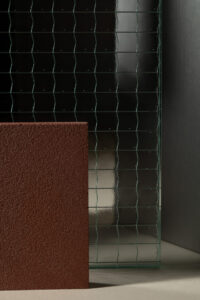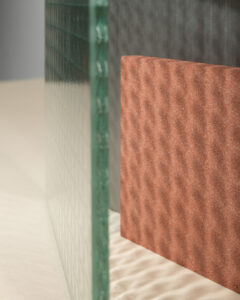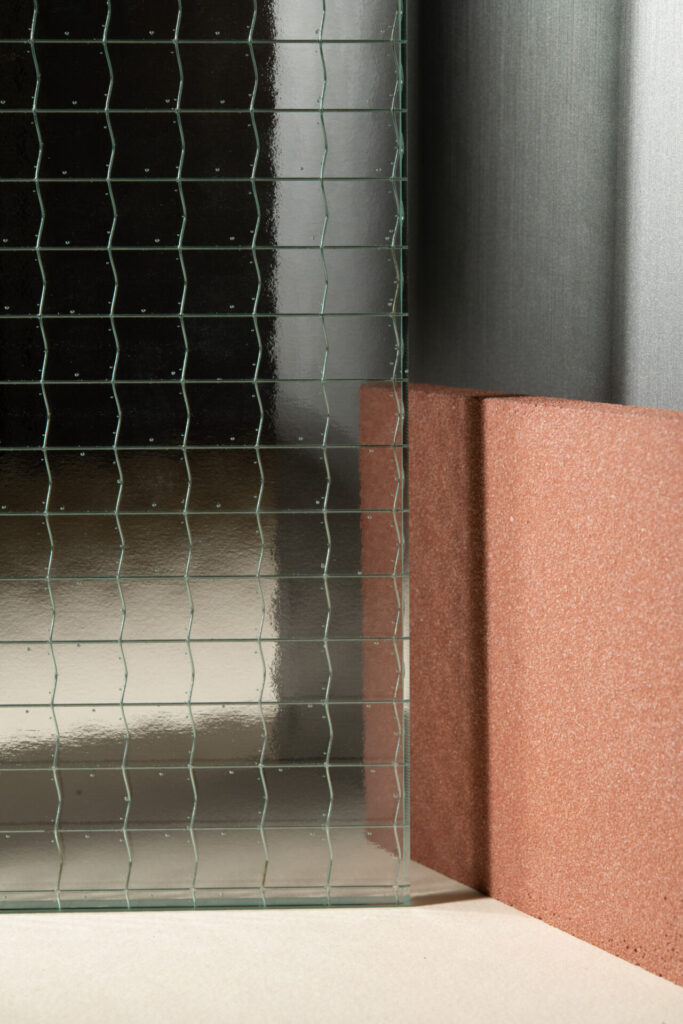
Materials are rarely experienced in isolation. Their character emerges through contrast, proximity and the way light moves across their surfaces. In this Material Library composition, terracotta-coloured concrete, ribbed glass and brushed steel become three distinct elements of the same visual landscape.
The first impression comes from colour. The warm, earthy tone of the concrete introduces a dense and tactile presence, establishing a solid background against which the other materials can change its perception. Its matte surface absorbs the light rather than returning it, creating a sense of depth that becomes more evident when placed alongside more reflective finishes.
The ribbed glass introduces a different quality. Its textured surface breaks up the view, allowing light to pass through while fragmenting what lies behind it. Transparency becomes less about seeing through a material and more about perceiving movement, shadows and changing degrees of visibility. As the light shifts, the regular rhythm of the glass creates a constantly changing pattern across the composition.
Brushed steel adds another layer to this relationship. Its surface catches and reflects the surrounding light without behaving like a mirror, producing softer variations of brightness and tone. In proximity to the concrete and glass, it becomes particularly sensitive to its surroundings, reflecting fragments of colour and light while introducing a cooler, more precise presence.
Placed together, the three materials create a conversation between opacity and transparency, warmth and coolness, absorption and reflection. Their differences are not resolved into a uniform surface; instead, they remain visible and become the basis of the composition.
This is also where the act of designing begins to resemble a form of experimentation. Working with materials means observing how they react to one another, how a texture changes beside a smooth surface, how colour is altered by reflection, or how a shadow can become part of the material experience.