Giada Storelli: The Instant of Change 2026 is a project that involved you alongside Struggente Studio. What did your contribution to the project consist of?
Castore e Polluce: We were welcomed into the beautiful space in the village of Soncino that houses Struggente Studio, where they had set up a darkroom. The project aimed to create nine images, three for each of the companies involved (Rexa, QuadroDesign, and Caesar), using the photographic development technique Man Ray called the Rayograph. While Luigi Fiano and Ardesia Coco of Struggente Studio handled printing and the darkroom processes, our role was to oversee the set design and explore the materials and how to use them.
GS: This project gives new meaning to and expands the possible uses of certain reclaimed materials. What kinds of materials did you work with? How did you use them, and what were the main challenges?
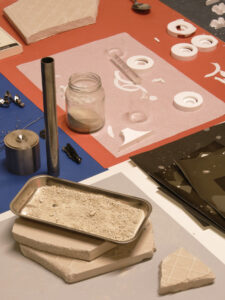
CP: Each company provided raw materials resulting from their production processes: Rexa contributed Corian® and Korakril™ in polished, solid or perforated sheets, as well as thin flakes; QuadroDesign provided stainless steel in solid or hollow cylinders and spiral filaments; Caesar contributed porcelain stoneware in fragments and powders.
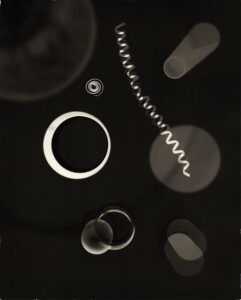
As we did not know in advance exactly how the technique and materials would interact, the work began as an experiment, starting from formal composition. We worked in the darkness of the darkroom, with only red light and no other lighting devices, positioning the objects carefully to avoid damaging the acetate and plexiglass. We then studied how photographic paper responded to light: by changing the paper and exposure time, we could modulate the greyscale and the depth of tones. Direct contact with the acetate produces sharp edges, while increasing the distance creates softer, more blurred outlines.
Building on these principles, we also developed compositions in height, using overlapping plexiglass sheets. The challenge was to translate a three-dimensional construction into a two-dimensional image, avoiding unwanted overlaps, balancing the visual weight of the different elements, and remembering their precise positioning. The technique offers only a partial reading of the materials’ physical qualities, which emerge primarily as silhouettes. In Caesar’s ceramics, the veining is not visible, while the powders create effects reminiscent of starry skies. With Rexa and QuadroDesign, on the other hand, geometric forms, heights, and the relationship between solids and voids also came into focus through light, alternating between overhead and side exposures.
GS: What were your main sources of inspiration?
CP: Our main sources of inspiration were Man Ray, Surrealism and the history of photography. It was also useful to study some of the tests Ardesia carried out in the days leading up to the meeting, which helped us outline an initial range of possibilities.
In the studio, we also had Wassily Kandinsky’s Point and Line to Plane with us, together with the work of Joan Miró, both of which influenced our formal and compositional approach. As the experimentation progressed, and as we became more familiar with the objects and tools and began to observe the first printed results, inspiration emerged spontaneously, giving rise to evocative images such as starry skies, moons and frames.
GS: Unlike a more controlled design approach, the darkroom made improvisation and discovery central to the process. How did you approach this new way of working?
CP: Improvisation and discovery were central elements and, in a sense, almost magical ones. The technique involved skills we already knew, such as composition, but it also forced us to step outside the conventional photographic process. Unlike a traditional set, where you can control and correct every element before taking the shot, here that control is lost, requiring a greater act of imagination.
In the darkroom, time and waiting become essential: they cannot be accelerated or avoided. Care and attention are not enough to eliminate the element of surprise that emerges when silhouettes and impressions of objects—sometimes difficult to recognise—gradually appear on the paper. It was a meaningful experience, and one we are deeply grateful for.
GS: The images produced in the darkroom take on a new form within an exhibition, alongside these and other materials and objects. How did you conceive this sort of Wunderkammer?
CP: The selection of objects displayed alongside the photographs and the materials used emerged after the images had been created, as part of an evolving process. The choice was guided by very different forms, weights and material qualities, reinterpreted through visual or conceptual associations, starting from simple, everyday objects.
Seemingly unrelated elements were brought together: a timer found in the darkroom, connected to the theme of time and waiting; an open book featuring an image by Man Ray, chosen for its visual and conceptual affinity; and Point and Line to Plane. In other cases, the criterion was purely formal, such as juxtaposing a coil of spiralled metal wire with a piece of passementerie from our archive.
The result is a Wunderkammer that is not a collection of objects, but a narrative device suspended between archive and experimentation, in which every element contributes to generating new meanings.
* The sixth edition of The Instant of Change explores the transformation of production fragments into unique photographic images. This edition, called Fragmenta, is curated by Luca A. Caizzi with Mo.1950 and supported by Ceramiche Caesar, Rexa and QuadroDesign.