Giada Storelli: The Instant of Change 2026 is a project that involved you alongside Castore e Polluce. What did your contribution to the project consist of?
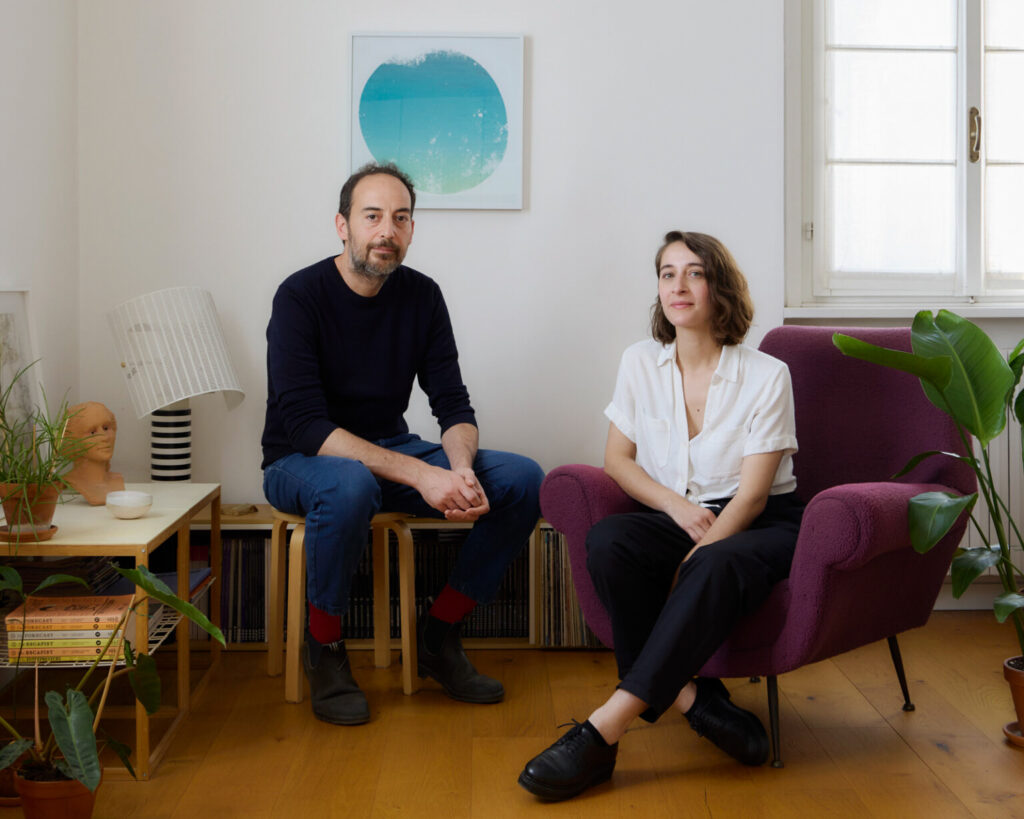
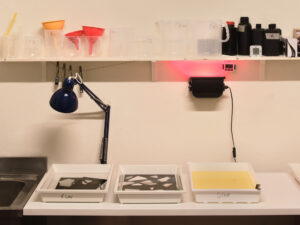
Struggente Studio: We conceived Struggente Studio around a year ago as a space for research and photographic practice, primarily analogue, reflecting our identity as a duo. Thanks to our expertise, particularly in darkroom processes, Mo.1950 and Luca Caizzi invited us to collaborate with Castore e Polluce on the Instant of Change project.
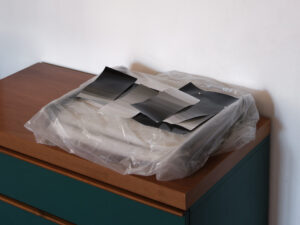
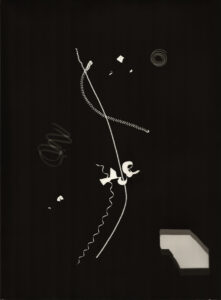
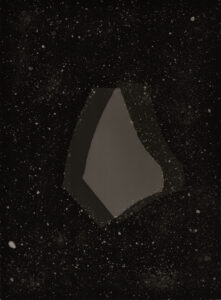
The result was a series of photograms, or contact prints, created using reclaimed materials from the brands Rexa, Ceramiche Caesar and QuadroDesign as their primary subjects.
GS: These reclaimed materials, originally used to create objects with a practical function, are employed in this project to generate abstract images and become tools for sparking thoughts and reflections, a cycle of meaning rather than function. How did you approach this? Did you already have a clear idea of what you wanted to create, or did you allow yourselves to be guided by the process?
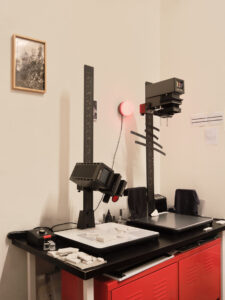
SS: The photogram is a technique based on light and a photosensitive surface onto which objects are placed. Their shape, density and transparency determine the final result. An object’s density, volume, form, and possible transparency all influence the effect achieved in the print. By its very nature, therefore, the photogram is an image intrinsically connected to the forms whose traces it seeks to capture.
Initially, we focused on the technical aspects of how the materials would translate into the print. Once we established these, we worked with the duo Castore Polluce to transform those effects into poetic, evocative images rather than simple, recognisable traces. The process was therefore highly experimental: we let the materials and the results that emerged through printing guide us.
GS: What were your main sources of inspiration?
SS: The period that inspired us most was that of the historical avant-gardes. Working with the photogram, it was natural to look at those who had experimented with this technique before us, such as Man Ray with his rayographs, László Moholy-Nagy and, more broadly, the Bauhaus.
From a compositional perspective, Wassily Kandinsky’s Point and Line to Plane was also fundamental. It helped us anticipate balances, tensions and rhythms between forms, the density of materials and the shades of grey characteristic of silver gelatin printing.
GS: As you have explained, the project is based on the photogram, one of photography’s most “essential” and primitive techniques. What value or meaning does a return to such a primordial gesture take on in a contemporary context?
SS: The photogram—the direct imprint of an object onto a surface—represents the very essence of photography at its origins. In the same way, the reclaimed materials used for these silver gelatin prints are foundational elements from which the objects of everyday life take shape: almost like primary signs, similar to those a designer uses to construct an idea.
In this sense, the photogram proved to be the ideal technique for rethinking these materials as essential presences, capable of generating both images and thought. This is where the project’s value lies: in the importance of direct experience and the ongoing search for the essence of things.
GS: Each print is the result of a process that cannot be fully replicated, dependent on light, chemistry and the arrangement of the objects—the opposite of the common idea of photography as a medium capable of infinite reproduction. How central is the idea of the unique piece to this project and to your practice?
SS: Rather than the idea of the unique piece itself, what was central was the need to create images that were closely connected to the materials of the different brands. The photogram makes this direct relationship with the object possible, but it is inherently unrepeatable. Unlike printing from a negative, here the objects are placed directly on the paper, exposed to light, and then removed before development.
This makes it impossible to reproduce exactly the same image. Even when attempting to recreate it, variations inevitably emerge. There is something paradoxical about the fact that such an original photographic technique is, in the end, closer to the uniqueness and immediacy of drawing than to photography’s traditional reproducibility.
* The sixth edition of The Instant of Change explores the transformation of production fragments into unique photographic images. This edition, called Fragmenta, is curated by Luca A. Caizzi with Mo.1950 and supported by Ceramiche Caesar, Rexa and QuadroDesign.